Furnace Not Turning On? 10 Things to Check
Furnace not turning on? Work through 10 checks, from thermostat and breaker to filter, igniter, flame sensor, condensate and door switch, and know when to call.
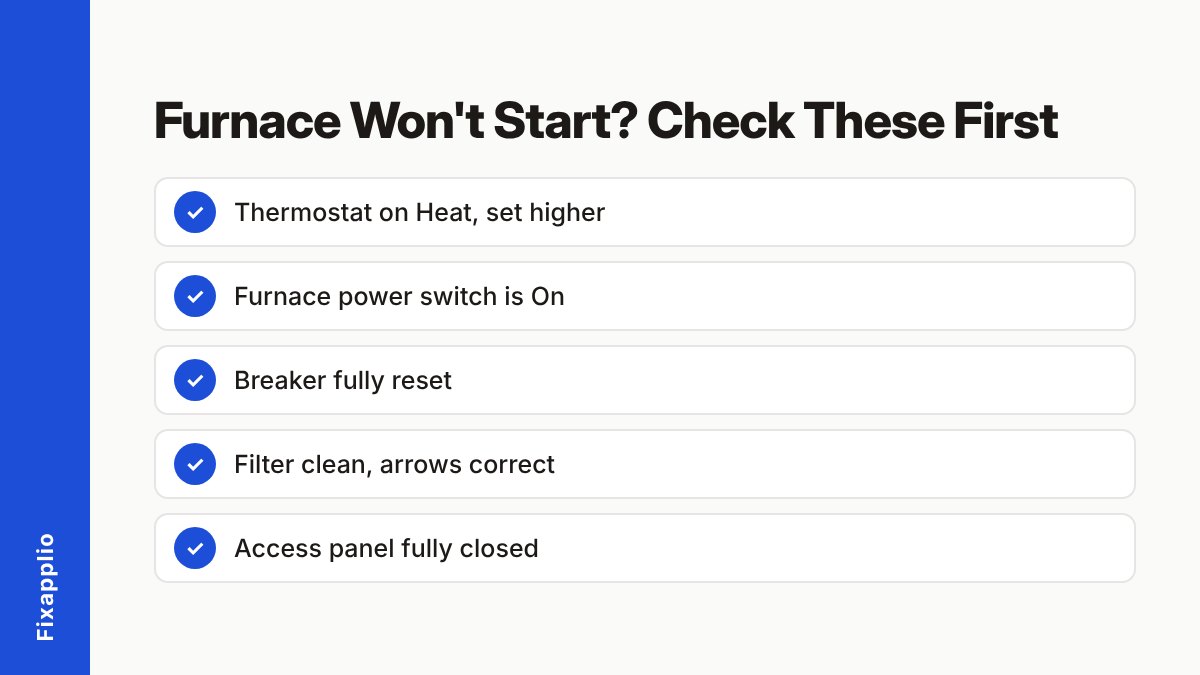
A furnace that will not start usually has a simple cause: the thermostat, a switch, a breaker, or a dirty filter. Work through the checks below in order, because the first five cost nothing and take a few minutes. Anything involving gas parts, the control board, or a gas smell is a job for a professional.
Quick answer
If the furnace is completely silent, check power first: thermostat settings, the furnace’s own power switch, and the breaker. If the blower or inducer starts but no flame appears, the cause is more likely the filter, a safety switch, the igniter, the flame sensor, or a blocked condensate drain.
Safety first
Gas furnaces combine electricity, gas, and combustion. Keep these rules in mind before you touch anything:
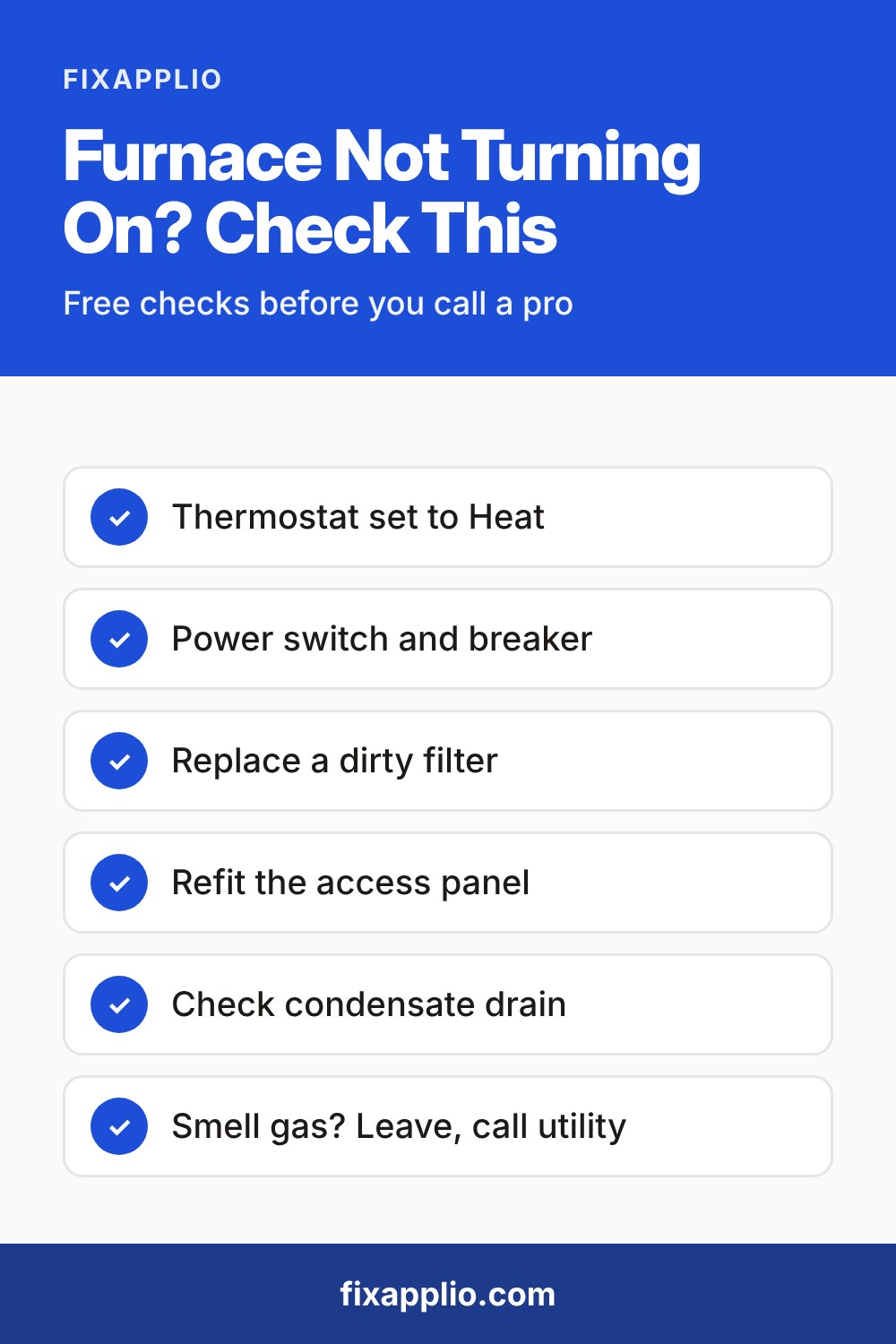
- Gas smell (often described as rotten eggs): leave the home immediately. Do not use light switches, phones, or appliances inside. Call your gas utility or emergency services from a safe distance. Do not try to fix anything.
- Carbon monoxide (CO) alarm sounding: get outside into fresh air and call emergency services. The US Consumer Product Safety Commission recommends CO alarms on every level of the home and outside sleeping areas.
- Turn off power at the furnace switch or breaker before opening panels, removing the filter, or touching the flame sensor.
- Refrigerant and gas-line work is not DIY. Refrigerant work requires a licensed technician (EPA Section 608 certification in the US), and gas valve or burner repairs belong to a qualified heating professional.
10 things to check, in order
1. Thermostat settings
Set the thermostat to Heat and raise the setpoint at least 3 to 5 degrees (F) above the room temperature. Check the batteries if it has them, and look for a blank screen or loose wires. Setting the fan to On is a quick way to confirm the system is getting control power: if the blower runs, the furnace has power and the problem is likely in the heating sequence.
2. Furnace power switch
Most furnaces have a switch on or near the unit that looks like a light switch. It is easy to flip by accident, especially during basement or utility room work. Confirm it is On.
3. Circuit breaker
Find the breaker labeled “Furnace” or “Heat.” A tripped breaker often sits in the middle position. Switch it fully Off, then On. If it trips again right away, stop and call a technician, because something is drawing too much current.
4. Air filter
A clogged filter restricts airflow and can cause the furnace to overheat and shut down. Turn off power, open the filter compartment, and replace a dirty filter with the airflow arrows pointing toward the furnace. Also make sure supply and return vents are not blocked by furniture or rugs.
5. Gas supply and gas valve
Confirm the gas valve to the furnace is open (the handle is typically in line with the pipe). If other gas appliances, such as the stove or water heater, also do not work, the issue may be the supply, so contact your gas utility. Never try to find a leak with a flame.
6. Door (panel) switch
Furnaces have a safety switch that cuts power when the access panel is off. If the panel is slightly misaligned, the switch may not engage and the furnace will not start. Remove the panel, refit it squarely, and make sure it is fully closed.
7. Condensate drain (high-efficiency furnaces)
High-efficiency furnaces produce condensation that drains through a trap and tubing. If the drain is blocked or the tubing is cracked, the pressure switch may keep the furnace from firing. Look for water pooling near the unit or a drain line that is kinked, cracked, or clogged. Clearing a simple clog in a visible drain line is reasonable for a careful homeowner; internal repairs are not.
8. Igniter or pilot light
Modern furnaces use an electronic igniter that glows before the gas valve opens. A typical start-up sequence is: the inducer fan starts, there is a short pre-purge, the igniter glows, and then the gas valve opens. If you see no glow, or the igniter looks cracked, it may have failed. Igniters are fragile and are best handled by a technician. Older furnaces use a standing pilot light. If yours is out, follow the relighting instructions printed on the furnace only if you are comfortable doing so, and stop if the pilot will not stay lit or you smell gas.
9. Flame sensor
The flame sensor is a thin metal rod in the burner flame that tells the control board the burner is lit. When it gets coated, the furnace may light for a few seconds and then shut off. With power off and the gas valve closed, many homeowners gently polish the rod with fine steel wool or fine emery cloth, then reinstall it. If the problem returns, the sensor or another part needs testing.
10. Error code and a single reset
Many furnaces have a small light on the control board that flashes a code. Match the flash count to the legend sticker inside the access door, because codes vary by brand and model. Then try one reset: set the thermostat to Off, wait about five minutes, and set it back to Heat. If the furnace has a burner reset button, press it once only. Pressing it repeatedly can push unburned gas into the heat exchanger. If it still does not start after one reset and a 30-minute wait, call for service.
Symptoms and likely causes
| What you notice | Likely cause | What to try |
|---|---|---|
| Nothing happens, no sounds | Thermostat, power switch, breaker, door switch | Checks 1 to 3 and 6 |
| Blower runs, no heat | Ignition or gas supply | Check gas valve, then call a pro |
| Starts, then shuts off quickly | Dirty filter or dirty flame sensor | Replace filter, clean sensor |
| Clicking, no flame | Igniter, gas valve, or safety switch | Note the LED code, call a pro |
| Water near a high-efficiency unit | Blocked condensate drain | Clear visible clog, check tubing |
| Breaker trips repeatedly | Electrical fault or failing motor | Stop and call a technician |
What you need
- Replacement filter in the correct size (printed on the old filter’s frame)
- Flashlight
- Fine steel wool or fine emery cloth (for the flame sensor, with power off)
- Screwdriver or nut driver for the access panel
- Your furnace manual, or the model number on the data plate
Common mistakes
- Skipping the free checks. Many service calls end with a flipped switch or a clogged filter.
- Pressing the reset button over and over. One reset is the guidance; repeated tries can let unburned gas build up.
- Working with the power on. Always switch off the furnace before opening panels.
- Using the wrong filter size or direction. Check the arrows on the frame and install them toward the furnace.
- Ignoring a repeating problem. If the furnace trips, short cycles, or needs resets again and again, something is wrong that a reset will not fix.
When to call a professional
Call a heating technician if:
- The basic checks do not restore operation.
- A breaker trips again after you reset it.
- The burner reset or rollout switch trips again.
- You hear banging, grinding, or squealing.
- You smell burning, or see soot or scorching near the furnace.
- The problem involves the gas valve, control board, igniter replacement, or inducer motor.
- The furnace needs repeated resets.
Call your gas utility or emergency services first, from outside the home, if you smell gas or a CO alarm sounds.
Sources
Frequently asked questions
Why is my furnace not turning on even though the thermostat is set to heat?
The most common causes are a tripped breaker, a furnace power switch that is off, a clogged filter, or an ignition problem such as a dirty flame sensor or a failed igniter. Start with the free checks (thermostat, switch, breaker, filter) before assuming a part has failed.
How long should I wait after resetting a furnace?
Turn the thermostat off, wait about five minutes, then set it back to heat. If the furnace has a burner reset button, press it only once. If it still will not fire after one reset and a 30-minute wait, call a technician.
Can I clean a flame sensor myself?
Many homeowners do, with the power off, by gently polishing the metal rod with fine steel wool or fine emery cloth. If the furnace still shuts off after lighting, the sensor or another part may need professional testing.
What should I do if I smell gas near my furnace?
Leave the building right away without touching light switches or using appliances. From a safe distance, call your gas utility or emergency services (911 in the US and Canada, 999 in the UK, 000 in Australia).